Most efficiency projects die in the budget queue, not in the engineering review. A food manufacturer in the US Midwest skipped the queue. The SET Alliance has now published the case study: a 185 kW Tamturbo® TT185 turbo compressor replaced a legacy system that had been drawing 200 to 250 kW around the clock, and the plant paid nothing to put it in.
The utility nobody watches
Compressed air is the one utility a factory must manufacture for itself. Electricity, water and heat arrive at the gate. Air gets made on site, hour after hour, and its cost disappears into a line on the electricity bill. The case study puts the scale of that at around 10 % of all industrial electricity consumption and roughly 5 % of total global electricity use.
For this plant, the number is not abstract. The site is a major food ingredient producer inside a global food company that runs group-wide climate targets, and compressed air accounts for an average of around 10 % of the electricity used across its plants. That makes it one of the larger single contributors to site CO2 emissions.
Where compressed air touches food ingredients, oil-free is not a preference. Legacy compressor technology can reach that purity, but usually by giving up efficiency to get there. The plant had been living with exactly that trade, at 200 to 250 kW of continuous draw, and it had stopped being good enough on either count.
A 185 kW high speed turbo compressor, installed as a retrofit
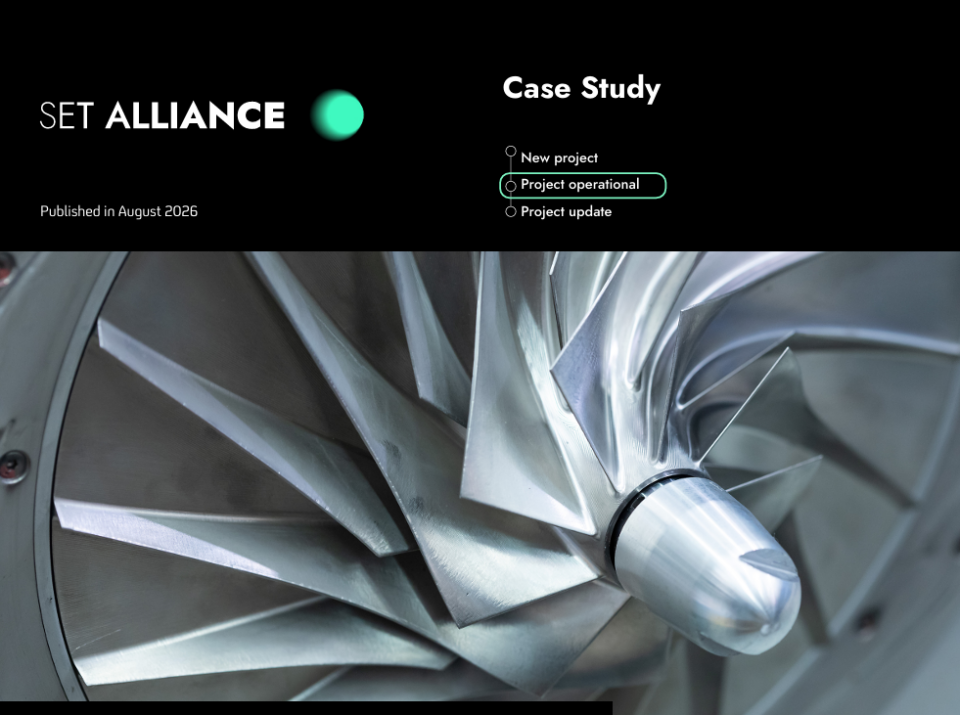
The replacement is a water-cooled Tamturbo® TT185 Touch-Free™ high speed turbo compressor. The rotor is suspended on active magnetic bearings, so nothing inside the machine touches anything else. No lubrication, no wear surfaces, no coating to degrade over the years. The air is 100 % oil-free because there is no oil in the compression process, not because a filter caught it on the way out.
A high-speed motor with variable speed drive control matches output to what the plant actually draws, instead of running flat and dumping the difference. Remote monitoring and bi-directional remote support let Tamturbo watch performance, troubleshoot and carry out 90 % of interventions without anyone driving to the site. Service is condition-based rather than time-based, so the machine is opened when it needs attention, not when the calendar says so.
Against the old system, the case study reports an estimated 10 to 30 % reduction in electricity consumption for compressed air production.
Sustainable compressed air without a capex decision
The commercial side is the part worth reading twice. Tamturbo’s as-a-service model offers several ways to pay: a fixed monthly fee, a variable fee based on the air used and the energy recovered, or a fixed base fee with a consumption-based element on top. Depending on the option, the arrangement can be structured off balance sheet under US GAAP or IFRS.
This customer went with the consumption-based option. Tamturbo keeps responsibility for the equipment, its performance and its maintenance for the full contract term, and the customer makes no upfront capital investment. There are no fixed capacity charges, a minimum monthly fee keeps service continuous during quiet periods, and the contract runs on a 12-month rolling term linked to a four-year initial term.
That structure is what lets the project happen at all. An efficiency upgrade normally has to win a capital budget round first, competing against everything else the plant wants to buy that year. Take the capital step out and the decision moves to where it belongs, which is total cost of ownership rather than purchase price. Tamturbo compressors also support energy recovery from hot water at up to 90 °C for use in other processes, available under the same model.
“Implementing impactful projects on our clients’ sites is Tamturbo’s priority.”
Hannu Heinonen, EVP, Tamturbo
Read the full case study
“Achieving Sustainability with CAaaS” was published by the SET Alliance in August 2026, with BASE as knowledge partner. It covers the background, the technical solution, the contract structure and the reported results in full.
More on how the model works in practice: Touch-Free™ Air, oil-free as a service with JustAir, and oil-free compressed air for food and beverage.
About the SET Alliance
The Servitisation for Energy Transition (SET) Alliance promotes as-a-service business models that put energy-efficient equipment into use without capital investment, and documents operational projects as public case studies. All information in the case study is the intellectual property of the SET Alliance.